The pain can be felt mainly in the buttock, leg, or foot when a lumbar nerve root is irritated or compressed.
Sometimes we hear the typical phrase: “My leg hurts a lot, but my back doesn't.” This situation creates confusion among patients who automatically associate spinal problems with lower back pain. However, it is possible to experience sciatica without lower back pain or with back pain that is much less intense than the leg pain. Sciatica describes a set of symptoms that can occur when one of the lumbar or sacral nerve roots related to the sciatic nerve is irritated or compressed. For this reason, the pain can be felt at a distance from the origin of the problem and travel through the buttock, thigh, leg, and even reach the foot.
A herniated disc is one of the possible causes, although other pathologies such as spinal stenosis and various degenerative conditions can also produce a lumbar nerve compressionDr. Bernardo Mosqueira explains that the fact that the patient doesn't have significant back pain doesn't rule out the possibility that the leg pain originates from a nerve root in the lumbar spine. For this reason, the location of the pain doesn't always coincide with the location of its cause.
Why sciatica can cause leg pain without significant back pain
The nerve roots that emerge from the lumbar and sacral spine travel through different areas of the lower extremities. When one of these roots is irritated or compressed, the brain can perceive pain, tingling, burning, numbness, or changes in sensation along the area corresponding to the nerve. Thus, a person may feel intense pain in the buttock or leg while experiencing only slight lower back discomfort. NHS It notes that the symptoms of sciatica usually affect the buttock and the back of one leg, and can extend to the foot and toes, and that although back pain may also be present, it is usually less intense than the leg pain.
The specific area where the discomfort occurs can provide information about which nerve root is affected. For example, a herniated disc at L4-L5 may affect the L5 nerve root, while a herniated disc at L5-S1 may affect the S1 nerve root. These differences and their potential symptoms are explained in more detail in our article on L4-L5 and L5-S1 disc herniationPain is not the only possible symptom. Some patients describe tingling, electric shock sensations, burning, or loss of sensation. When these changes reach the distal part of the limb, a sensation of [unclear meaning missing in original text] may occur, for example. Foot numb due to herniated disc.
The progression of symptoms provides a wealth of information, explains the neurosurgeon: "Knowing where the pain begins, where it radiates down the leg, and whether there are any alterations in sensation or strength helps identify which nerve root may be involved." However, not all leg pain is sciatica. Muscular, joint, vascular, and other structural problems can also cause discomfort in the lower extremity. Therefore, it is important to consider the entire range of symptoms and not base the diagnosis solely on the location of the pain.
How to know if leg pain may originate in the spine
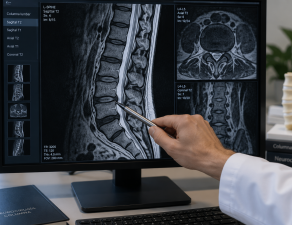
The evaluation begins with a medical history and a neurological examination. The pain pathway, sensation, muscle strength, and reflexes can provide information about possible nerve root involvement. When indicated, magnetic resonance imaging (MRI) allows for the study of the lumbar spine to check for a herniated disc, stenosis, or other abnormality that could explain the symptoms. However, finding a lesion on an MRI does not automatically mean it is responsible for the pain: there must be a correlation between the images and the patient's symptoms.
Treatment will depend on the cause, the severity of the symptoms, and their progression. Many cases may initially improve with conservative management. When there is persistent nerve compression, a significant limitation in quality of life, or relevant neurological involvement, other treatment options may need to be considered, including surgery when indicated. The onset of recent or progressive weakness requires immediate medical evaluation. If symptoms such as loss of sensation in the perineal area, difficulty initiating urination, or loss of bladder or bowel control are also present, urgent medical attention is necessary.
Having sciatica without lower back pain It's possible. The fact that the back is barely bothering you doesn't rule out the possibility that a nerve root in the spine is causing the pain felt in the leg. Correctly identifying the source allows us to establish the appropriate treatment for each patient. At Dr. Mosqueira Clinic, we perform an individualized assessment of spinal problems, correlating symptoms, neurological examination, and imaging tests to determine the cause of each case.
Dr. Mosqueira Clinic | Malaga
655 021 907 | 951 006 638
Frequently Asked Questions about Sciatica without Lower Back Pain
Yes. The pain can manifest mainly in the buttock, leg, or foot when there is irritation or compression of a lumbar or sacral nerve root, even though the lower back area may produce little discomfort.
Yes. A herniated disc can affect a nerve root and cause symptoms along its path, even without severe lower back pain.
The pain can start in the buttock and spread through different areas of the thigh and leg, eventually reaching the foot. The path can vary depending on the affected nerve root.
The distribution of symptoms, the examination of strength, sensitivity and reflexes and, when indicated, magnetic resonance imaging allows us to assess whether there is nerve involvement of lumbar origin.
The onset of recent or progressive weakness requires urgent medical evaluation. Symptoms such as loss of perineal sensation or new changes in bladder or bowel control require urgent medical attention.