
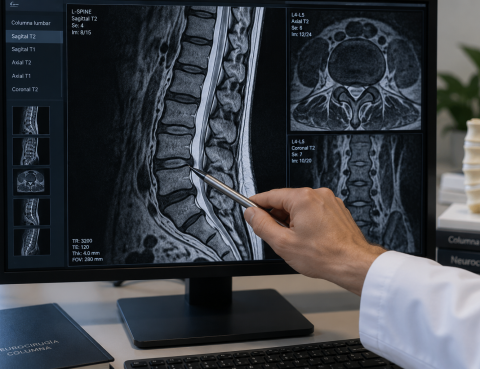
Seeing "disc protrusion," "herniation," or "extrusion" on an MRI scan raises many questions. We explain what these terms mean and why the diagnosis also depends on the symptoms and the examination.

Choosing the right professional is one of the first steps toward obtaining an accurate diagnosis and the most appropriate treatment for each patient. Receiving a diagnosis of a herniated disc or suspecting that the pain may be related to this condition generates one of the most common questions among patients: Which specialist treats a…

A herniated disc and spinal stenosis are two of the most frequent causes of lumbar nerve compression and require accurate diagnosis to choose the most appropriate treatment. To begin, let's answer the question: what is nerve compression? The spine protects the spinal cord and nerve roots…

Current microsurgical techniques allow spinal surgery to be performed in the summer with a rapid recovery and a reduced hospital stay. With the arrival of summer, many people who have been living with lower back pain, herniated discs, or problems stemming from spinal stenosis for months ask themselves the same question: Is this a good time…

Surgical experience, patient outcomes, and specialization are some of the factors that make the difference in spinal surgery. When someone looks for the best spinal surgeons in Spain, they are actually trying to find something much more important than a name or a list. They are looking for trust, experience, and…

Radiating pain, tingling, or weakness can be signs of a herniated disc and require a specialist evaluation. A herniated disc is one of the most common spinal conditions and a frequent cause of lower back and neck pain, as well as nerve compression. Many people begin to notice progressive discomfort that eventually affects…

Knowing when to operate on a herniated disc or spinal stenosis helps in making more informed and confident decisions. Every patient is different, and each condition affects them in a unique way. One of the most frequent questions in consultations is whether a herniated disc or spinal stenosis requires surgery. Many patients arrive…

Patients who have regained mobility after spinal surgery using microsurgical techniques and personalized treatment

Understanding the current treatment options for herniated discs in Spain is the first step towards regaining your quality of life. Back pain that keeps you awake at night, sciatica that radiates down your leg, tingling, or loss of strength inevitably lead to the question: what is the most suitable treatment for…

Understanding the anatomy of the spine, from vertebrae C1 to S5, is key to understanding many pathologies, interpreting medical diagnoses, and choosing the most appropriate treatment. Pathologies affecting this group of bones prevent us from enjoying a good quality of life and cause intense pain. The spine can be understood as a large…