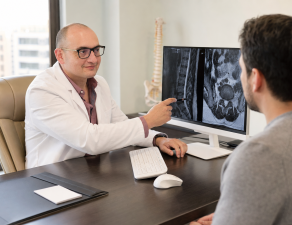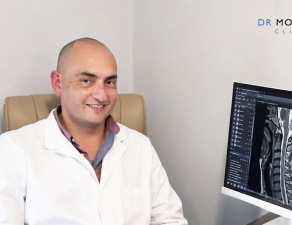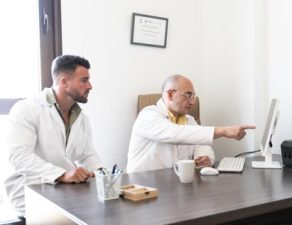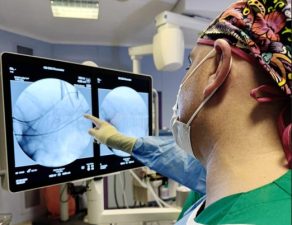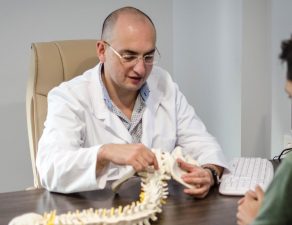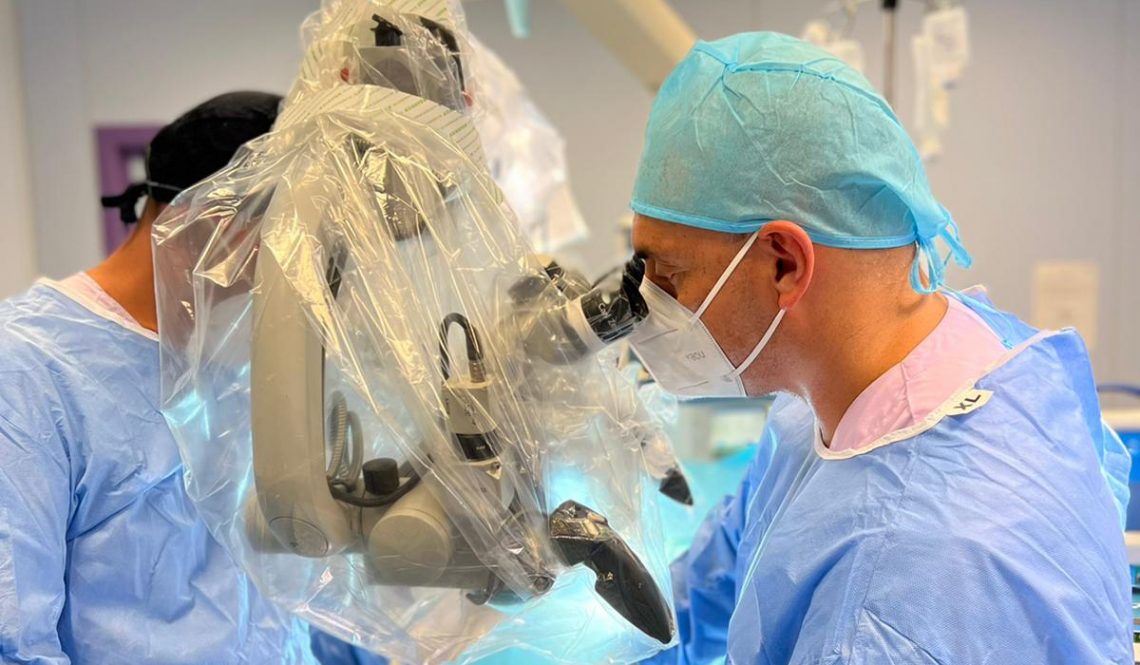
Dr. Bernardo Mosqueira has been at the forefront of neurosurgery for over 25 years. He is also well-versed in minimally invasive techniques (microsurgery). His specialty is disc herniation and spinal stenosis, both in the lumbar and cervical regions.
Our neurosurgeon's presence on social media and in the media is constant. Some time ago, Top Doctors Spain wanted to meet with Bernardo Mosqueira to discuss neurosurgery in general, focusing on herniated discs and microsurgery. We want to share with you the highlights of that interview, where Dr. Mosqueira answered various questions.
What is a herniated disc?
It is a condition in which the nucleus pulposus of the disc bulges out of its proper position and compresses a nerve structure. A vertebral disc is made up of the nucleus pulposus and the annulus fibrosus; when the latter weakens, a herniation occurs. It occurs when it compresses an important structure, such as a nerve root or the spinal cord, which triggers the symptoms..
Is there a profile of people who are more affected?
Rather than hernias, it's better to say that lumbar or cervical spine pathologies affect people with more sedentary lifestyles, those who are obese or overweight, those who perform strenuous physical exertion, or those without protective gear...In this type of people there is a higher prevalenceHaving a weak core promotes the development of lumbar disc herniations. I strongly urge my patients who come in not only with a hernia but also with lower back pain to strengthen the muscle group surrounding the spine. This can be achieved through exercise, yoga, Pilates, and other very specific exercises that can be easily learned with a personal trainer.
What types of hernias exist?
There are lumbar pains, which are the most common, followed by cervical pains, and finally thoracic pains. The main difference between the first two is that compression in the lumbar region is root-mediated, causing intense radicular pain in the leg, which completely incapacitates the patient. Cervical pains can cause compression of the root and also the spinal cord (cervical myelopathy). On the other hand, the approach to thoracic pains is very complex; thankfully, there is a minimal percentage, and their occurrence is rarer. I could say that in 20 years, I've been able to operate on two or three; it's a different story.
Therapeutic treatment or straight to the operating room?
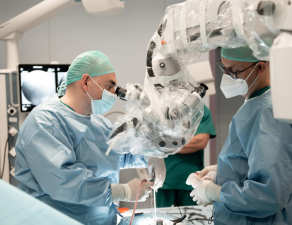
The first step is always to try medical therapy with painkillers, anti-inflammatories, a course of corticosteroids, and/or neuromodulators to help the root return to its original location or improve the pain. At that point, we would wait two months, and if there's no improvement, there's little chance of achieving quality of life through medical treatment. From that moment on I opted for microdiscectomy, a small 3-centimeter approach in which we preserve the structure (ligaments) and joint, and remove the hernia compressing the root. The structure is preserved, and the remaining disc continues to perform its function of cushioning the spine. The patient's recovery is faster; they are up and walking within 6 hours, on the floor within 12 hours, and home within 24 hours.
If you need a diagnosis or surgery, at Dr. Mosqueira Clinic we provide you with every possible means. We always like to inform our patients and friends, and also help them in any way possible. If you would like information about any medical topic or need a consultation with us, microsurgery may be the solution to your herniated disc. Do not hesitate to contact us at 951 00 66 38, we will be happy to assist you with whatever you need.
Newsroom Vere Álvarez