La cervical spinal stenosis It primarily affects people over 50, primarily due to age-related bone wear. But do we know the causes, symptoms, and treatment of this condition? Don't worry, we'll answer all your questions so you know what we're talking about.
If a few days ago we talked to you about the lumbar spinal canal stenosisIn today's post we are going to update you on the cervical spinal stenosis.
What is cervical spinal stenosis?
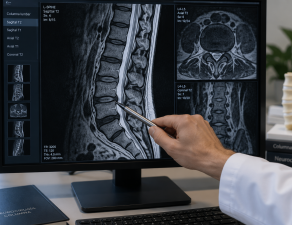
Cervical spinal stenosis is a narrowing of the spinal canal at the cervical level.
As we well know, the spine is composed of vertebraeas well as a spinal cordWell, when the vertebrae narrow, the nerve roots of the spinal cord can be affected, and even the spinal cord itself. That is, when the canal narrows, the spinal cord can be compressed, as can its nerve endings.
What is its main cause?
As we have already mentioned, one of the main cause is age-relatedYes! I'm sorry to say that even if we maintain our youthful spirit, our bones feel the dreaded passage of time.
The passage of time causes our bones to wear down, in turn generating a deterioration of ligaments and cartilageThese conditions are the main causes of spinal canal narrowing.
Symptom
They are generally recognized the following symptoms:
- Stiffness, tension, and pain in the back of the neck.
- Loss of strength, numbness, or weakness in arms, legs, and hands. Opening a container can become a difficult task.
- Difficulty walking, maintaining balance, and coordination problems. This can lead to frequent falls and, consequently, the need for a cane.
- Kidney problems and incontinence.
What treatments are there?
In mild cases of cervical spinal stenosis, a conservative treatment (non-surgical). This treatment basically consists of various types of exercises, anti-inflammatories, analgesics, and physical therapy. Conservative treatment is also recommended for patients at high surgical risk.
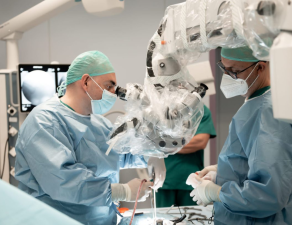
However, in cases of loss of strength and/or sensitivity, where a severe neurological deficit is observed, a surgical interventionThe main objective of this intervention is to prevent the disease from progressing and allow the patient to return to a normal, discomfort-free daily life.
If you'd like to learn more about cervical spinal stenosis, please don't hesitate to contact us.
-
Hello Doctor, I'm a follower of yours and I would like to know how much cervical surgery costs. I have pain in my arms and hands, and when I walk, I feel dizzy.
-
Good afternoon, José Pedrosa. If you'd like more information, please call 951006638. We'll be happy to help you there. Best regards.
-
Hello Doctor, Good Afternoon!
My name is Edgar and I am from Cuba.
I have calcification of the cervical vertebrae and cervical stenosis.
I have a stiff neck, I can't look up or to the sides, it's limited.
I would like to know what treatments there are for this?
Here they tell me about an operation on my cervical spine, but I know that any operation in this area has many risks, so I wonder if there is a noninvasive operation for this type of stenosis.
Please, I'm from Cuba, I can't call you, so I'd like you to write to me at my email.
I also have photos of the CT scan I had recently in case you need them.
Greetings from Trinidad, Cuba,
Edgar -
Good afternoon, friend Edgar. I understand you perfectly. To be able to help you, I would have to see you in a consultation, and according to what you tell me, you're very far away. To give a diagnosis, I must perform a consultation examination, since that's the correct course of action, and each patient presents with a different pathological picture. To better recognize these types of problems, I recommend an MRI. Best regards, and good luck.
-
Hello, I live in Florida, Miami, I have PERIPHERAL NEUROPATHY due to cervical stenosis, I had to have surgery but I didn't, what do I do now?
-
Good evening, I'd need to see you in consultation to give you a diagnosis. It's the correct way to examine you. If you're coming to Spain, don't hesitate to call us at 951006638.
-
Thank you very much, Doctor, for your response. Excuse me, it was only today that I saw your response.
I would like to ask you one or two more questions:
1-Through a friend, a neurosurgeon saw my CT photos and told me that I may have a OLLP, but as you suggested, an MRI is needed to define it correctly.
On average, how long does it take for this disease to progress to critical?
I started having a stiff neck 2-3 years ago. But, since last week, I've been feeling something strange in my hands and feet, sometimes yes, sometimes no.
Should I hurry up and get medical attention with what I'm telling you?2-If I could travel to your country, Spain, how much would a consultation with you cost? And for example, an operation like this? More or less, how much?
3- Is there any minimally or less invasive surgery to treat this disease at this time?
4- I also have had arrhythmia: extrasystoles for some years. I have been told that these operations involve intubation through the trachea. Is it necessary this way? Or is there another way?Excuse me, many questions, but I would like to know how to proceed.
Again, Greetings from Trinidad, Cuba.
-
Regarding your questions, I'm sorry to say I'd have to see you in person to give you a diagnosis; a personal examination is vital. Regarding point 1, you'd need to see an MRI, as you say. The progress of the condition depends on the intensity and the individual. Some people recover in a matter of weeks, while others never do. Regarding the second point, I'd have to see you because I don't know what the problem is. Call us at 951006638. We always opt for minimally invasive microsurgery, except in some exceptional cases. I'd have to answer all of these questions when I see you. I'm sorry I can't do so without knowing your situation firsthand. Best regards and a big hug from afar.
-
Thank you very much Doctor for your answers to my questions.
Thank you so much for everything!I will try to call you on your number to get more information and to talk about what I have.
Sorry for not responding sooner, I didn't see your kind reply until yesterday.
As always, I send you and your entire team greetings from Trinidad, Cuba!
Edgar
Good evening to you. -
Good morning, doctor. I have this condition and would like to know your opinion on a mild C5C6 disc disease accompanied by a right posteolateral disc herniation that extends to the neuroforamen, causing mild stenosis of the canal and severe monoforaminal stenosis.
This is the result of the MRI. Could you tell me if I will have to undergo surgery or treatment? Since I passed my finger, I have been numb and have pain in my arm, armpit, and armpit next to my chest and neck.
Thank you very much -
Good morning, Vanessa. In order to help you, I'd need to see you in person and get a diagnosis. Call us at 951006638. We'll help you. Have a great day.
-
Hello and Good Morning Doctor!
Greetings from Trinidad, Cuba.
Edgar Falcón again,
A question,
As I told you before, I have a stenosis of the cervical canal, I think due to an ollp, in c2-c3 and c3-c4.
My question is: Is this operation very complicated in that area?
Are there minimally invasive surgeries for this problem in this area of the cervical spine?Greetings!,
Edgar -
I would like to contact you for cervical spine stenosis.
-
Good morning, José. We're here to help. Call us at 951006638 and we'll help you. A big hug.
-
Good morning, doctor. After an MRI, the conclusion is that I have severe stenosis in both foramina and moderate stenosis of the spinal canal. I've been suffering from cervical pain for half my life, and my body has reached the point where enough is enough. Do you think this could be corrected with surgery?
-
Hello, my friend Luis Fco. Come visit us so I can give you a diagnosis. Call us at 951006683. Best regards.
-
Good morning, could this assessment cause me dizziness and weakness in my arms?
Thank you very much Rectification of physiological lordosis.
Height, alignment and signal intensity of the vertebral bodies without
significant alterations.
Small left subarticular protrusions at C2-C3, C3-C4 and C4-C5, without signs of root compression.
Broad-based protrusion lateralized to the right at C5-C6 that imprints the anterior thecal sac and causes mild right lateral stenosis, without signs of root compression.
Spinal cord with normal morphology and signal intensity.
Craniocervical junction within normal limits.
Muscle groups assessed without evidence of significant alterations. -
Good afternoon.
That's right, my friend, but seeing how complex the case is, I must see you in consultation to give you a diagnosis.
Call us at 951006638 and we will help you.